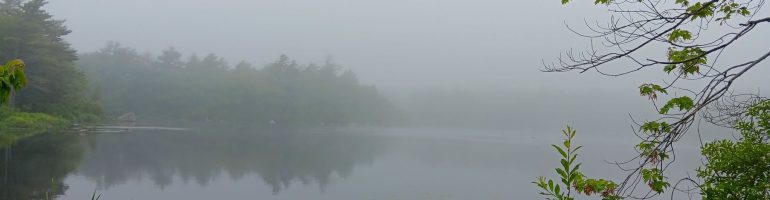
Crows are causing a ruckus outside, perching on tree branches. My cat blissfully sleeps, either unaware or uncaring of them. The sky is overcast, a typical Maritime day. The overcast sky, fog and lively crows hint at fall’s arrival. The next turn in the Wheel of the year is the autumn equinox. Autumn is creeping in…
I updated my writing desk. I measured the length and width of the desk and bought a meter and a half of black broadcloth. I arranged it on my desk and I laid a lovely black spiderweb tablecloth on top. My skull who I call Hamlet, sits on my desk next to my pen organizers and my computer, coffee cup (used! of course), books, gemstones, and my keyboard and mouse pad. The desk looks more gothic now. I love it, and my witch broom from the Ukraine and my black bat figurine hang on the wall next to the window. A very inspiring writing desk area! I love it.
Two months from now, Aracnhall will come to life again. Dreamweaver Press, the imprint of Twisted Dreams Press, is re-publishing my gothic spidery horror novella, The Cult of the Spider People. I am excited, knowing this horror story will once again be building spiderwebs on bookshelves or on Amazon!
Before you open those pages, armed with a smoking hot coffee and a comfy spot to read, here are four things to know before entering Arachnall if you hope to leave alive!
Four Things to know Before Entering Arachnall
Arachnall is accessible by first entering a portal
When Piper and Cory accidentally stumble on the spider-infested and horrifc world of Arachnall, Cory’s inhaler lies just past the portal, the black door. Piper is forbidden to enter the portal. When her father leaves town on a work trip for the weekend, she defies her father and learns the hard way what lies past the forbidden door. Then her and Cory must find a way to escape with their lives.
Arachnall is a deadly and darkly magical world.
Forget Labyrinth or your favorite Grimm Brothers stories. Arachnall is a world where the Human Centipide may feel right at home. Here is an excerpt from Cult of the Spider People:
“An enormous black spiderweb, extending twenty feet, reached across the cavern’s roof. Weird spidery creatures crept across the web woven of solid silk. They rebuilt and wove new webs and cocoons. More minor nets fastened to the central one. Viscious cocoons large enough to hold an adult human being hung suspended from the gruesome web. Piper gasped, frozen in fright. “It’s a hive,”. It’s a hellish sight and all I want to do is run.
Here is another excerpt from the book: “Something struggled in a cocoon above their heads. She wanted to run from the cavern but her limbs were leaden. The creatures beat the cocoon with their large, powerful legs. Piper’s heart lurched. Terrified screams rang out from inside the cocoons. She stepped forward but Cory restrained her. He pointed above them to where a cocoon swayed dangerously. She hoped the creatures would miss them. A pitch-black creature appeared above, suspended from a glossy strand of silk. They exchanged fearful glances, frozen in place. Piper held her breath, sure the creature would hear the hammering of her heart. The monstrous limbs beat the cocoons. Its prisoner howled in terror. The movement rippled through the webbing and the cocoons rocked back and forth. Another cry rang out in the air.”
Arachnall is ruled by an overlord, the Spider King, greedy, beyond evil and possesed with a bloodthirst who makes Shelob from Lord of the Rings look like a pansy. Here is an excerpt from the book:
“She didn’t want to look at him, but she couldn’t tear her gaze away. He was more awful than any she had previously seen. A face carved from death, painted with fresh blood, a body so terrible. Piper hoped to wake from this nightmare and closed her eyes for a second. When she opened them, he was still there and he laughed. Piper’s blouse was damp with sweat and mildew from the slimy cocoon. She cringed from the odor and the clamminess. Roth, the Spider King, bowed his head in greeting to the other creatures. His gaze penetrated through the grisly cavern. He sniffed the air. The creature’s eyes were twin orbs of true pitch-darkness. He wore a black crown of spiders. His cheekbones were sunken, and his hide was charcoal black. Dried blood matted his lower jaw. Eight bristly angular legs protruded from his cephalothorax. His sardonic laughter permeated the cavern.”
Roth, the Spider King, covets Piper and he plans to make her his new queen. He has chained the Spider Queen, trapping her in her own lair which is even more deadly than the cavern. Aranya, the Spider Queen, refuses to share her pure blood/ venom with Roth and the other Arachnas. Piper has other plans.
No one emerges from Arachnall alive.
“The lair of the Spider Queen was a hundred times worse. An enormous black web spanned twenty meters swaying like a spectral ghost. The lair was replete with decrepit skeletons. Dead insects, humans and animals hung from the web like baubles. Spiderling Arachnas wove silk cocoons, eager for an unwary victim. The stench of blood permeated the lair.”
That is enough to give the most jaded horror fan nightmares.
Most of the unlucky victims find themselves in the portal and hardly remember how they got there. Then they are confined to cocoons, literally waiting for their turn to die. The way they die is well … you have to read the book to learn more.
The Cult of the Spider People will be available in October 2026. Follow this blog for more horror and shivery dark delights!
Join the dark side. Get new horror, Gothic, paranormal and writing articles delivered directly to your inbox. Want more Gothic horror, paranormal writing and dark literary musings? Join my email list.
Darkness has always been a central staple in horror fiction and movies. Authors have used darkness in a variety of themes and visual ways.
It is harder to portray darkness in a character, internal darkness in fiction rather than movies. There is internal darkness and then there is external darkness. The internal darkness resides within the character. That character is not necessarily the villain, but the character does dark things as a result of their own internal darkness. A classic example is Frankenstein. He creates a monster out of hubris, is horrified by his creation then abandons him. His creature is forced to fend for himself and ends up rejected by society as well. Jack Nicholson’s character in The Shining is another classic example of internal darkness. He hurt his son’s arm in the past, but as they live in the hotel and time passes, his character becomes more and more psychologically unraveled and then tries to kill his own family. The ghosts in the hotel have manipulated him into giving into the darkness. I love this story because it is a classic example of psychological horror. The real scare is what he becomes. Internal darkness – the darkness within a character may be scarier than a dark hall, a serial killer waiting for you in the closet, or anything else you can imagine.
If the internal darkness represents a real threat and is not contained, then the horror ensues.
Now let’s look at external darkness as a horror theme. Sharks, a shadowy hall, spiders, bats, a haunted abandoned asylum, an eerie moonlit cemetery. These are all examples of external darkness. You enter a house believed to be haunted, dared by your peers and enter it to save your reputation. First, you see the cobwebs along the old ceiling and the hallway walls. Okay, no big deal. Your footsteps shuffle on the floor. Your heart pounds and you break out in a sweat. Darkness surrounds you. The sound of your heart pounding and your own breathing fills your ears. A mouse squeaks or a door slowly closes on its own and your adrenaline spikes. Shadows dance in the darkness. You tell yourself that is impossible. The rocking chair creaks on its own. You want to run, but your peers taunted you and you know you have to tough it out or risk losing the respect of your friends waiting outside- or did they abandon you? Then you see something shift or enter/ exit from a room. But you know no one lives there and it was abandoned years ago. The shadow or ghost (whatever you believe it to be) starts moving toward you? Does it limp? Shuffle? Slither? Crawl? Okay that’s it. You believe you paid your dues and say screw it- you don’t care how long they tease you, you’re outta there. You open the door – maybe the doorknob is old and a little sticky, so you struggle with it and as the thing catches up to you, you feel its breath on your neck, but you manage to wrench the door open with seconds to lose and scuttle down the front porch steps. You dare yourself to glance behind you. You made it. You are not waiting in there for more horror.
It is the duty of a good horror author to know what darkness is. That darkness can be internal, happening within the character or external, like the haunted house. A good author knows the difference and knows how to use both elements well to scare his readers. When done effectively, the result is a memorable horror story. I believe that the best horror authors might understand darkness well, because they have it in within themselves or they have seen that darkness in people around them. They survived trauma, abuse, neglect, had parents with addiction issues or are abusive. They saw something that strongly affected them and can’t quite forget it, such as something not quite right in a cemetery or a fight betwen their parents or a unreasonably angry teacher as a child at school. They might make the best horror authors because they put what they truly see or feel onto the page. The reader connects with the characters on a deeper level because it resonates within the reader. They identify with the characters and begin to worry for the characters and that keeps them reading. They stay up till 3 am and curse the author.
When I wrote The Cult of the Spider People, the story was a culmination of several things that had to do with my ex and old witch coven I was in. The book was the result of my ex’s selfishness, his narcissistic personality and how irresponsible he was. The fact that so many people turned on me that I believed were my friends. The book is a result of my heartbreak and I believe that writing it was cathartic. My ex-boyfriend was never interested in redemption, quite the opposite. It is a dark, powerful story.
So dare yourself to explore your own darkness or what you see around you whether that be in people or in the world. Pour it onto the page. One warning: You do not have to traumatize yourself. It is a good idea to maintain a balance.
The Fire Is Lit: Tales from the Hearth Is Now Published
Greetings, Darklings:
Today’s post is all about a brand-new anthology release titled Tales from the Hearth, published by Twisted Dreams Press. I am very excited because one of my short stories is included in this anthology, along with wonderful stories by many other talented authors.
When Baynam Books Press closed its doors, Twisted Dreams Press generously agreed to republish the works of the authors who had been published by Baynam Books. Tales from the Hearth was originally scheduled to be published by Baynam Books, but unfortunately, that never came to pass.
It has been a long wait for this anthology, but I am sure it was worth the wait!
Tales from the Hearth is now available on Amazon in Kindle format and through Kindle Unlimited.
It’s Publication Day for Dreamweaver Press, a division of Twisted Dreams Press!
We are thrilled to announce the release of our very first anthology, Tales from the Hearth! This collection of horror stories by 15 writers is sure to send chills down your spine! Congratulations to the writers included in this book!
It’s available as an ebook and through Kindle Unlimited.
Paperback coming soon!
Here is the book’s blurb:
Tales from the Hearth is a collection of stories both shocking and horrific! From spine-tingling tales of woodland horror to monsters preying on young victims, these stories will chill and delight fans of horror stories that make their skin crawl!
This anthology includes work from the following authors:
Bryan W. Alaspa Nemo Arator Shannon Bradner Dawn Colclasure Zach Ellenberger Matthew J. Gleason Boe Healy with Chisto Healy Emmanuel Herrera Whitney R Holp Heddy Johannesen C Lenz Eric Otero Destiny Pifer Christine N Rifkin Isabelle Robinson
Dare to read these chilling stories of horror that can only come from storytellers gathered at the fire, eager to share their tales of terror!
Don’t miss out on this collection of terrifying tales! Grab your copy today and check out some amazing stories that will haunt and horrify you until the very last page!
The anthology will soon be available in paperback format. I will definitely be snagging a copy for myself, and I can’t wait to read it from cover to cover!
There is something wonderfully fitting about an anthology called Tales from the Hearth. There is an ancient tradition of gathering around a fire and sharing stories—some comforting, some strange, and some that send shivers down your spine. I am thrilled to have one of my own tales gathered among these stories.
In Other News…
I have even more publication news to share!
My article about the forsaken dead went live two days ago on Paranormal Daily News. I shared the article in a previous post here on the blog for anyone who would like to read it.
I also have a poem and a short story scheduled for publication in 2027. Both will be published by Dreamweaver Press, the imprint of Twisted Dreams Press.
And, of course, I have two books coming out in October: The Cult of the Spider People and The Mourning Tide!
I am SO excited about these releases! I will be sharing much more about both books during our favourite spooky month of the year—October!
We are Halloween People, and we are proud of it.
We will always be Halloween People. 🎃🖤
Augtober Is Upon Us!
Yes, Darklings, Augtober is upon us!
I felt positively wonderful slipping into a lovely black lacy dress today. I usually wear black anyway, but the intense heat and humidity have been driving me crazy. I had to pull out all my lovely pure cotton summer dresses just to survive!
But now it is time to dive back into that dreamy October vibe.
The humidity is unreal, so I think I shall hide away, keep cool, and savour every word of the new anthology Tales from the Hearth.
Explore the tragic history of poor houses in Halifax, Nova Scotia and disrespect for the dead. Immigration and overpopulation seem to happen cyclicly and cause immense societal problems for everyone except the wealthy minority.
Halifax is no stranger to tragedy, a tragedy steeped in blood and suffering. In 1758 a bill was passed to create an asylum strictly for the poor, a convention that had origins in Victorian England. The first poor house, also known as the Poor Asylum, was built on Spring Garden Road across from the courthouse and completed near Christmas in 1759. The property is now known as Grafton Park. There were several smallpox outbreaks in the poor houses, the worst of them occuring in 1827 due to immigration and overpopulation in Halifax.
A new poor house was constructed on the corner of Robie and South streets in 1867, where IWK Health now sits. Builder Henry Peters hired an architect David Sterling whose building plans were in the form of a “Latin cross, with four wings descending from a central building, which measured 180 feet long, 50 feet wide, and four stories high.” The completed main brick building stood five stories high, with a French style roof and soon housed the elderly, orphans, mental patients, sailors, medical patients and inebriates.
The Old Burying Ground was adjacent to the poor house on Spring Garden Road. It was believed to house the remains of 800 people. People who lived in the poor house were not allowed at St. Paul’s Cemetery. Today, Grafton Street Park and the Halifax Memorial Library have erased the history and sight of the poor house and burying grounds.
Halifax poor house corruption, bleak conditions & fire tragedy
The poor house was very underfunded and led by corrupt managers. The conditions in the poor house were terrible and patients suffered whipping and stocks. One patient was found chained and wearing a dog collar that pierced his throat and neck if he moved. The people who lived in the poor house were expected to work hard and contribute. They helped to stoke the furnace, and worked in the kitchen, the hospital, the garden or cared for the livestock.
The building was destroyed by a fire on November 6, 1882 in the wee hours of the night. The fire was believed to have begun in the laundry room in the northeast section. Some claim it started in the kitchen. It claimed the lives of the most defenseless people – the elderly, the infirm and mentally ill who were asleep in their beds when the fire began. They were so unwell they may not have been able to comprehend what was happening. The patients had nowhere else to go.
See page for author, Public domain, via Wikimedia Commons
The Halifax Fire Department arrived quickly, but the fire raged out of control. The building’s layout confused the firemen and panic spread amongst the patients. 31 people died in the fire. Most of them were residents of the poor house that were not able to be rescued in time. The tragedy gained significant public attention about the inhumane conditions of the asylum.
The firemen helped many inmates escape the fire. They rushed up to the upper sections of the building and carried the inmates who were sleeping or were unaware of the fire at the time. Two clergymen were rescued. One man was exhausted from smoke inhalation and the other had almost suffocated. A woman stood at the window on the fifth floor, her arms resting on the ledge with her hands clasped. Sadly, she fell backwards into the devouring flames. Her screams rang out mingled with the screams of the other patients who were not able to be rescued. Nothing could be done for them.
Prior to the tragic fire, a total of three hundred twenty inmates lived in the poor house. 42 of those patients were in the hospital. The inmates that were fortunate enough to have escaped sought shelter in outhouses and stables. The main building was engulfed in flames. Most of the building could not be saved. The hoses used to extinguish the fires were destroyed. During that time, a man was spotted on the uppermost story of the western wing. Smoke billowed out the window the man was looking through. Behind him, the flames raged. The brave firemen were determined to rescue him. The firemen raised ladders. The man eagerly climbed down the ladders and reached the ground. He was Mister James White, of the number one division, (Salamander) U.E.C. The rescue was just in the nick of time. After his escape, the window was in flames. The adjoining buildings were saved.
Another building was constructed in the same place by 1886. The asylum was renamed City Home in 1907 and remained as a hospital for mentally unwell patients until its eventual closure. In 1972, City Home was torn down and Abbey Lane was built.
Halifax Poor House fire inquiry
There has not been such a fire in Halifax since that tragic time. The amount of casualties is the highest ever recorded in Halifax’s history. After the tragic fire, an inquiry was held to investigate the conditions of the poor house. The conditions revealed overcrowding, insufficient fire safety, and outdated wood construction. The conditions for the patients were indeed inhumane. A hundred people died annually at the poor house.
Fire breeds change. Changes were in store for the patients who endured harsh conditions in poor houses in Halifax. The fire marked a turning point in the conditions the patients suffered. Reforms were set in how the province cared for the mentally unwell. New institutions were built that were meant to improve safety and guarantee more humane living conditions. The fire is remembered not just for the tragic loss of life, but also that broad social changes were made for public health, welfare and reform in Nova Scotia.
In 1913 construction workers unearthed human remains and bones. There was very little speculation about how that happened. 20,000 bodies are buried in what is now a parking lot for St. Mary’s Basilica and the surrounding areas. One of those areas was the corner of Grafton Street and Spring Garden Road, near the courthouse. The Old Burying Ground was connected to St. Peter’s, the first Roman Catholic Church in Halifax. It no longer stands and has since been replaced by St. Mary’s Basilica.
Halifax Poor House gives the old court house a grim reputation
Old Halifax Courthouse
SimonP at the English-language Wikipedia, CC BY-SA 3.0, via Wikimedia Commons
The old Halifax Courthouse is a prominent Classical Revival building constructed between 1859-1863, designed by William Thomas and Sons. The building features a classical stone facade made with durable sandstone from Wallace, Cumberland County. Its style features an imposing facade, classical pediment and Tuscan columns.
Set back far from the sidewalk and grass, the building was expanded on over time. Between the years 1881-1882, a rear addition was built for county courts. In 1908 a west wing was added and in 1930 an east wing was added. In 1969 it was designated as a national historic site and served until 1971 as a provincial courthouse until a new waterfront law courthouse was opened downtown. From then on, it briefly served as a provincial law courthouse, and was restored in 1985.
The dark history of the poor house gives the old Halifax courthouse a grim, unsettling reputation. A grassy park now disguises the poor house that interred those who were mentally unwell and impoverished.
A long forgotten necropolis
The Old Burying Ground, the church, the church parking lot and the other nearby buildings are a long forgotten necropolis. The parking lot of St. Mary’s Basilica contains 3,000 bodies. The Old Burying Ground (also known as St. Paul’s Church Cemetery) was established in 1749 opposite the courthouse and closed in 1844. The remains of 12,000 people were buried there. The Old Burying Ground contained the most preserved mortuary art, an odd fact considering there were very few headstones for the many graves. It was designated a national historic site in 1991.
In 1958 a petition was made to pave over the cemetery to make it a park for local businesses. The public outcry defeated the petition. The other cemeteries in Halifax were not so fortunate. A cemetery existed near the Old Burying Ground for the Jewish community since the 1750s, but no longer exists.
Paulo O from Halifax, Canada, CC BY 2.0, via Wikimedia Commons
Across the street from the Old Burying Ground, the church and the courthouse, stands the old Halifax Memorial Library. A committee met in 1945 to decide on building a war memorial in Halifax. It was agreed that the war memorial would be in the form of a library. Over the years, the library amassed a number of items such as flags, memorials, plaques, a Silver Cross replica, a Book of Remembrance, and murals. There are two Books of Remembrance: the first one contains the names of people who died in WWI, and the second contains the names of people who died in WWII and the Korean War, donated in 1955 from Silver Cross Canada.
A cornerstone stands near the library and bears the inscription, “This building was erected in memory of those who gave their lives in defence of their country 1914-1918 1939-1945. For their faith – for their courage – for their sacrifice, we will remember them.” Grafton Street park rests in front of the main entrance of the library and features a statue of Winston Churchill which was unveiled in 1980. Where today people enjoy tea or a snack on colorful benches and savor the fresh air, was once a burial ground for the inmates of the poor house. Park visitors heading either uptown or downtown, may be unaware they are walking over unmarked graves. This small cemetery was in operation for a hundred years from 1761. 4,500 people were interred there. When the Halifax Memorial library was being built, countless human remains were discovered. The inmates were as unfortunate in death as they were in life.
The Presbyterian Church of St. David stands near the library and overlooks Pizza Corner. Between the years of 1793 and 1844, the church was the burying place for Halifax’s Methodists. The interred bodies were forced to make way for more construction. A wooden church was erected where the bodies were buried. The church burned down and was replaced with a brick and stone building that still stands today.
In 2016 and 2017 more construction forced the 244 dead who were buried there to be buried again in a new spot. The Old Burying Ground is the only cemetery that has national historic site status. The other nearby cemeteries have been destroyed and paved over.
Halifax Memorial Library Hauntings
Halifax Memorial Library
Nova Scotia Information Service, Public domain, via Wikimedia Commons
The Halifax Memorial library closed in 2014 and was recently designated a historic site. That is good news for the ghosts who reside in the library, and the bodies buried underneath and near the library in the park. One afternoon, I was using a computer in the library and felt a hand on my shoulder. When I turned to see who it was, no one was there. I hurried to another section of the library.
Today, Halifax Central library stands on another chapter of Halifax’s history, the Bellevue House, built in 1801 for the Duke of Kent when he was the Commander of the Army in Nova Scotia. It was a popular spot for the military and was the social hub for 100 years. Parties were a weekly occurrence with hundreds of guests attending, up to as much as 600 people. One of those socialites was Adele Hugo, daughter of Victor Hugo. Another was Charles Austen, the brother of Jane Austen. Bellevue House was torn down and became a parking lot. That changed again in 2011 when an archaelogical excavation began in preparation for the construction of Halifax Central Library. The excavation unearthed dozens of artifacts from 1800 to 1850.
1850 was a booming time for Halifax. Some of the objects that were found included wine glasses, a pearlware platter, children’s mugs, even cobble remains of the horse stables along Spring Garden Road, a large water cistern and a rock drain system. A privy was also found which contained other objects dating back to 1850 such as a pearlware chamber pot. Those items lay buried until the excavation occured.
The Halifax necropolis of the poor house dead are long forgotten, their unmarked graves paved over for a park or condominium. It is a sad reality in the modern world, but not as sad as the fates of those who suffered and perished.
Horror has many well-known monsters that range from serial killers to brain eating zombies to Godzilla. Today’s post is about an overlooked type of monster: the sympathetic one. It’s my opinion that there ought to be more sympathetic monsters. I will tell you why I feel that way.
Most monsters in horror novels and movies fascinate us. I believe that the best monsters are sympathetic. Take the most famous one of all, Mary Shelley wrote Frankenstein. The mad scientist’s creature breaks our hearts and fills us with dread at the same time.
The monsters in my novella The Cult of the Spider People are NOT sympathetic but Piper is. She begins as a human being in the novella and by the end, she transforms with agonizing pain into an Arachnas. Piper yearns to be human, but she will never be human again. She does not wish to feed on blood to sustain her existence. She does not want to harm anyone, but she has no choice. The Arachnas were never in human form. They are eerie, blood drinking spider people.
The ghost in my novel The Mourning Tide bears a curse. He is forced to carry the seaweed that choked and was on his body when he was murdered, and he carries sadness everywhere with him. Jonathan, the ghost, accepts the painful fact that he may never be saved from his unbearable lonely existence and that his murderer who is alive and well may never be brought to justice. All that changes when Rosemary arrives and moves into his home. Jonathan was a mortal. He had a family that he loved. That was all taken from him.
Sympathetic monsters add a human element to their existence and form. A tragedy may have made a monster into what he or she or it is. It takes us by surprise when we least expect it. I remember when I lived in this one house with my family. We had a rodent problem, but one of those rats stands out in my mind. The rat did not bite or run or burrow. It just sat there with sadness, old and feeble. It wanted to die, to be released from a painful existence. So my older brother and my mother put the rat into a pot. They drove far away from our home, and released the rat. I think it died alone, but maybe with more dignity. Ending suffering is a humane thing to do. A rat is not a monster, but it does prove that we should not always be so eager to judge.
That breaks my heart. Most people fear rats. Rats are furtive and hide and their appearance give people the willies. But rats are misunderstood. They are extremely intelligent. Spiders are misunderstood yet they move into our homes to control the insect population. But people overlook the efforts of their web weaving allies and try to kill spiders with chemicals, for example. I never harm spiders. I know they are my allies and are allowed to weave their magnificent webs. Their appearance does make people uncomfortable. But they are an apex predator. They kill off many pest insects and we should be thanking them. We would all have a much bigger problem if it were not for the amazing efforts of spiders.
What may be a sympathetic monster to one person may not be seen in the same way by another person. A spider is not a monster, yet people fear them and will do anything to be rid of them. A rat is not a monster, yet people fear them. Bats make people uncomfortable, but they eat tons of mosquitoes. I have a great deal for spiders, rats and bats. They are treated like vermin, but they have done nothing wrong. Spiders. rats, bats and even seagulls, bluejays and crows are just being what they are. That is to me, the best type of monster. It is just being what it is.
A creature that can’t help what it is, that people find themselves relating to in one degree or another is better than something contrived. People like to live in their homes and live their day to day life without problems. They don’t want to see the dark side of nature- me included. I did not watch the movie about an android doll Megan or Annabelle or Chuckie. I can’t relate to those dolls. They seem to just be in a horror movie for the sake of the movie. But when I watched Mary Shelley’s Frankenstein that Robert DeNiro starred in as the creature, I bawled my heart out and I was terrifed at the same time. That stayed with me. I will never forget how the creature won my heart and broke it.
I am a Witch. I suppose in one sense I could be seen as Other, a rebel, a free spirit, a cauldron burning, moon worshipping Witch who dares to stand out from the norm. Does that mean I am a monster? I am seen as different. Well no I am technically not a monster, but I have seen parents cover their children’s eyes or cut ties with me permanently. I am viewed as Other, of not belonging to the normal – whatever normal really is – of society. I would not change what I am though for anyone. A crocodile is just a crocodile, but they hunt and they have to feed and mate. Tarantulas, spiders, monkeys, scorpions, vultures and black widow spiders make people uncomfortable. They are not monsters in the technical sense, but people are wary of them. They just are what they are.
The most dangerous and most inhumane monster on earth is Man. By that I mean, that it is man’s damage to the environment, to the entire earth that has caused many animal speicies to go extinct. Man has caused 60% of the animal life on earth to go extinct since 1970. That is a huge number. So who is the monster here really? A creature with scales, webbed feet or fangs? Or a creature that lives in a high rise with a car emitting dangerous toxins in the air or a man working for a company that is destroying the Amazon rainforest with no thought to the consequences of their actions? I ask you to reflect on this and ask yourselves… are we the monster? Owls live in trees that get chopped down to make way for a highway, trees that provide us with oxygen, bear fruit or house a family of squirrels. The oceans are polluted and there is no thought for the squids, fish, whales, dolphins or algae or sharks that live in them and have their own families.
The destruction of the earth is by no means sympathetic. It reflects greed, corruption, complete and utter destruction with no regard for the life that lived there. That is so unforgivable. When a being, human or not, is aware of its actions and has no empathy, that is dangerous. That is a monster. Mankind has caused corruption, climate change, greed, apathy, poverty, destruction of the earth, wars, famine, disasters. Not the seagulls, bats, rats, vultures, gargoyles or spiders. Nope. Because they wouldn’t. I hope we realize soon that we can’t take money to the grave. It means nothing when we are rotting in coffins. Money will mean nothing then. Those tall skyscrapers, fancy cars or massive yachts are just material possessions and objects. They are not reflective of the bigger picture in life.
Like I say, the best monsters are the sympathetic ones. The ones who terrify us or reflect our own fears back to us and yet win our hearts at the same time. I want to read a novel or watch a movie about that.
Today’s post will focus on why I write, or conjure, gothic horrors. I have always loved the shadows, the dark places that maybe others want to overlook or pretend aren’t there. I call those shadows home.
I have always felt like I never fit in. I have always been treated like an outsider. It used to bug me, but I guess I was never meant to fit in. Now I embrace my weirdness. I am glad I didn’t fit in. What does that mean, anyway? In today’s chaotic world, we need more nonconformity than ever. I love horror and the macabre, the dark, shadowy places few would dare to tread.
Being a Witch was a big part of me embracing my weirdness. That may not work for other Witches, but it does for me. It is personal to me. I’ve taken that outsider feeling and created characters in my stories that are outsiders, too, in their own way. Normal is relative, anyway. It is also boring.
Monsters can be, well, monstrous. I created vicious and deadly spider people in my published novella, The Cult of the Spider People. They are terrifying because they act like spiders even though they appear part human. They never think like humans. They crave blood, they are a monstrous size, far more powerful, and it is impossible to reason with them. They exist in darkness, hunt in darkness, and rip you from the light into their darkness, into smelly, moldy cocoons.
Their cave has a massive web where people are trapped in cocoons, praying to be saved, trapped in a world that does not care. That is so Lovecraftian. They speak a different language, they never consider the consequences of their ungodly actions, and they follow the Spider King. They live for the blood. Bones and skulls litter the ground. Sticky spiderwebs snare an unwary human. There is no hope of escape.
Monsters can embody our darkest fears. They can reflect fears back to a person. A monster can be anything, from the tiniest, most harmless spider to a giant squid crushing a submarine in the deep, dark ocean depths. Okay, for me, being trapped in a submarine at the mercy of a giant squid would give me nightmares. How the hell do you escape? How do you escape Arachnall?
By contrast, I wrote a novel that has a monster with a very different story, The Mourning Tide. The novel features a monstrous ghost. The townspeople shun him and act like he doesn’t exist. He is forced to exist with an unbearable loneliness until Rosemary arrives in the town.
She moves into his house. She is grieving the loss of her husband, Henry. She is heartbroken and yearns to be alone to dwell in her own grief. The neighbors are not helpful at all when she asks questions about the ghost Jonathan. Jonathan knows the truth: he was murdered. Rosemary is put to the task of finding the murderer, bringing him to justice, and setting Jonathan free into the light.
He is very human under all that seaweed he bears. He is cursed to carry his grief with him.
So what truly makes a monster? It could depend on what you perceive a monster to be. That can be a strange alien with tentacles or King Kong. If you had never seen a whale before, would you consider it to be a monster? Is an alien like the Greys a monster? Is a monster an embodiment of your fears, like in The Babadook? The Thing? A rattlesnake?
It could be anything that is alien or unfamiliar to you, something so odd and strange you do not know what to think of it. But is there sometimes something more to them, something tragic and human under all those scales or tentacles? Maybe the best monsters are the most sympathetic, such as Frankenstein’s creature. I like to think so.
A monster in your stories should not be just a monster. It can represent something, be symbolic. Show us our deepest, darkest fears when we most want to look away. Some monsters embody a sinister darkness, terrifying and omnipotent, and some are monstrous and yet there is something intrinsically human about them.
Piper is human in the novella The Cult of the Spider People, but at the end of the book, she is a monster—and yet a sympathetic monster.
A thread of hope runs throughout the whole novella, even when Piper is transformed. She is a sympathetic monster because she yearns to be human again, but that is now impossible. She made a huge sacrifice.
To find out more, you can buy the book on Amazon when it is released again in October, at the beginning of the month. I also have signed copies available. I can help pay for shipping if anyone wants a signed copy! The new edition will be released in October. That’s only a few months away!
A thread of hope runs through The Mourning Tide, my other horror story that will be released on October 5, 2026. Yes, I have the wonderful fortune of having two of my horror novels released in October. One more reason to love Samhain!
The publisher is home from the hospital, but she has to rest. The publishing schedules were shifted. Nothing could happen until the publisher was home from the hospital. She has to rest. I wish her the best, and I hope you can all wish her the very best, too!
The thread of hope in The Mourning Tide is that we root for Rosemary and hope she succeeds in her quest to help Jonathan cross over into the light, finally finding peace.
Here we have two stories, with hope and monsters and heart.
I am now working on a new horror novel. I will enjoy discovering the voices of the characters, the theme, the plot, the setting, and, of course, the monsters, be they human or horned!
Today’s post is about the tools we use to write. Do you take your keyboard or phone for granted? Do you, if you are like me, scribble with abandon in a black blank journal? ? I like to do both. I scribble and I type at a keyboard. I now have a new keyboard. My previous one worked, BUT the letters on the keyboard buttons were so old I bought stickers so I would know where the letters were and which was which. Over time, those faded too, so I got new stickers to replace the old stickers. But I had to put the stickers (I made myself) onto the old stickers. They faded fast.
We may never consider the tools we use to write or create. I have taken my keyboard, phone and yes, even a coffeemaker for granted. I love my new keyboard. The new one is much larger and new and clean. I love it. I possess a LOT of pens, pencils and many markers. I own many blank journals that I have to fill up with my latest imaginings, musings or inspirations. My desktop monitor stand is full of junk I have collected over time. I have two cups brimming with pens, markers and highlighters that rest on either side of the desktop stand. I love my knick knacks, goddess statues, and I even made myself a cute halloween themed mug coaster!
It is so nice to finally have a new, bigger keyboard. I plan to take good care of it. I now have no excuse not to write. I also bought a new hardcover book titled The Marshall Plan for Novel Writing by Evan Marshall. It is about a 16-step program to take an aspiring writer from idea to completed manuscript. I owned this book before. I must have donated it. I regret doing that, but I have a new copy now. I am going to do my best to create an outline using the advice and the system detailed in the book The Marshall Plan. I was freewriting the new novel idea I had, but then I hit a wall, something that happens to a lot of authors. The book helps authors knock down that wall, enabling them to keep writing and creating. I plot or build the outline for my novel on what Evan Marshall calls, section sheets. I can’t wait to get started. Once you have an outline, then you know how to move forward. This will be so much fun and may involve some frustration. The good thing is, if you don’t like the way it goes, you can always change your outline. It is not carved in stone. I think Evan Marshall is brilliant.
All writers and creators need tools. I use a sewing machine and a seam ripper, scissors, thread, a presser foot to sew. I use pens, journals, highlighters, a keyboard and coffee to write. Sometimes, I have a glass of wine. We all need our tools. We trust them, we use them over and over, and usually they serve us faithfully. And it is also important to remember to be environmentally friendly with our tools too. I might donate old pens and pencils to a women’s shelter, or to an animal shelter. I take old printer toner cartridges to Staples to be recycled. We don’t need to contribute to the terrible problem of landfill. I much prefer to donate to a good cause.
I’m writing this blog post with my new keyboard. Instead of throwing the old keyboard away, it was put in storage for a rainy day. Much better than throwing it right away into landfill. It still works, it was just very faded. I do need a new mousepad. The one I have now is dingy and stained, signs it was very much used. Since my boyfriend bought me the keyboard, I am quite inclined to get my own mousepad. I might put the mousepad I am using now into storage too. I will do anything to help the environment.
Writers commonly use a blank journal, computer, keyboard, pens, pencils, highlighters, and paper to write. These are great tangible tools. We have other tools at our disposal that are not tangible. If we did not have them, we would not get much writing done. Perseverance, patience, imagination and yes, even stubborness. A writer uses their imagination to come up with a great idea for a novel, or a screenplay. We need the patience and the perseverance to get through writing the entire thing even when we grit our teeth and think we will never get through it. Then we need even more of that to endure editing it to within an inch of the stories’s life, and then we need that again to get through trying to get it published. I have waited years – and I mean, years to get my spooky novel The Mourning Tide published. Now it will finally happen. During all that time, I kept editing it and kept resubmitting it. I came close to publishing contracts, even got nice rejection letters, and it finally happened. I highly recommend being grateful and patient when you land a contract. If you are easy to work with, they may sign you again for a second book. But that is a big, hard odd. It does not happen without effort. The writer makes the effort.
Imagination, perseverance and patience are a writer’s greatest tools. I use those tools all the time. I would say that patience is the most important tool. Things can happen slowly even when a book is under contract, especially then. I signed a contract with Dreamweaver Press a year ago for my novel The Mourning Tide. It will be published this October. I just wish my grandparents were still alive to see my book in print. Maybe they are watching over me. I hope so.
A few more tips:
Save your receipts when you pay for pens or a new keyboard or a snazzy mousepad. You might need them when doing your taxes.
Be earth friendly!
Donate your writing tools to a good cause when you are done with them.
Trust in your imagination!
Believe in yourself! If you don’t, who will!
I like to go on long nature walks. We have to take breaks from writing or we will be burned out. Live. You have to live to write. Don’t force yourself into a box.
Help your fellow writers. They will help you. It’s an equal exchange of energy.
Never give up. The Universe always falls in love with a stubbon heart.
I gathered flowers and herbs this morning. I want to press them and then mount the plant specimens in a three-ring binder. I will make good use of the new binder, the white sustainable printer paper, glue sticks. Actually, I have to stock up on glue sticks. I press the flower(s) first, wait for them to be pressed, and then I arrange them on the page to find a design that I am happy with. Then I glue them onto the page and include a label . The label includes information about the plants such as the day I foraged them, the weather conditions, the flower I chose, the binomial name of the herb or flower, the origin, color and what exactly I foraged- bark, seed, fruit, etc. That all tells me where I found the plant, what I foraged, and the date I found it, etc. I plan to make my herbarium into a collection of plants that are all grown locally. I am quite happy with the progress so far. I store the piece of paper with the dried, preserved flower and the label in a clear page protector and put it into the binder.
I even made my own herbarium labels. It is nice to know I am continuing a longstanding tradition of the preservation of beautiful plants. All the plants will be arranged in alphabetical order. I could organize them according to the plant family if I wanted. I think just going with an alphabetical order will suffice, for now.
I also plan to include a monograph of each collected plant specimen and a witchy monograph. I will store all that in the binder. I hope I am able to collect lots of plants. A monograph offers even more identifying information about a plant, including its medicinal properties. I hope to gather an impressive collection of plant specimens with medicinal properties to guide me on my plant journey over time.
I want to focus on cosmic indifference as a theme in horror fiction. Cosmic indifference may have its deep roots in Lovecraftian fiction. It has been a popular theme or trope in horror fiction ever since Lovecraft’s stories were published- and celebrated.
Cosmic indifference means that there may be a point where people realize that humans are totally insignificant to ancient forces. We all know we are really tiny in the vast, vast universe. But being insignificant to an ancient cosmic force is different. They are not the same thing. I am no expect on cosmic indifference. I have a hard time reading Lovecraftian fiction and I bought a beautiful tome of Lovecraft’s writing. I had to close the book. I am ready to give up on understanding Lovecraft. I will try one more time and ask for more help. I really want to ‘crack the code’, so to speak.
I write about the trope/ theme of cosmic indifference in my novella The Cult of the Spider People. Dreamweaver Press is republishing it in August! I am so excited.
My characters Piper and Cory unwittingly push back the veil to the dangerous realm of Arachnall and step through the portal. When they find themselves trapped, they are met with savage beings that crave their blood and are absolutely indifferent to their suffering. The Arachnas possess the same cosmic indifference, they do not care about their fate. Their indifference is so extreme that it’s terrifying. That terror carries through the entire novella. The stakes are high and danger is everywhere. Humans are nothing but a blood feast to the Arachnas.
They trap their human victims in cocoons. The cocoons are large enough to fit an adult human, whether male or female. They do not care about your gender if they want to kill you. They have no mercy, no warmth. Their world is dark, dangerous. Sinister. Surreal. The Arachnas do not free their prey, they wait until they want to feast on blood. There is no escape, no hope, nothing.
The indifference of the Arachnas to their human prey is terrifying. Readers can see Piper and Cory’s efforts to survive the savage and dangerous world of Arachnall in the pages of my soon to be republished novella out in August.
Twisted Dreams Press is publishing an anthology of horror fiction. My story, I am proud to say, is included! I can’t wait to read the anthology, titled Tales from the Hearth!
“Dreamweaver Press is thrilled to reveal the cover for our very first original anthology!
Tales from the Hearth is a collection of stories both shocking and horrific! From spinetingling tales of woodland horror to monsters preying on young victims, these stories will chill and delight fans of horror stories that make their skin crawl!
This anthology includes work from the following authors:
Dare to read these chilling stories of horror that can only come from storytellers gathered at the fire, eager to share their tales of terror!
Cover design by Crystal Baynam.
COMING SOON!”
I’m excited about my book being published – again! and the anthology! I can’t wait to read the stories written by the other talented authors in the book! I hope it’s released soon.
I am quite happy today. Though it was more expensive than I would’ve liked, I purchased the domain for this blog site. Now it truly is mine! The website address is now: theparanormalquill.blog.
Today’s post will focus on our famous eight-legged friends, spiders. Spider horror thrills readers. Spiders have always scared people and shall continue to. Spiders are uncanny and cause a knee jerk reaction. They have too many legs and eyes. They are quiet and cunning. People are scared of being bitten by them. Horror movies are made about spiders that cause nightmares long after the movies are over. They build webs and are a lethal predator and yet they never make a sound. It’s no wonder they make people nervous.
Spiders represent the dark side, like bats, snakes, gargoyles, witches, demons, sharks, wolves. The side that most people do not like to think about. Spiders are deadly predators and kill many other insects. We owe a lot to spiders yet people drown them in chemicals like Raid or scream and freak out if a person thinks they walked unwillingly into a web. Yes, spiders make people uncomfortable.
The webweaving arachnids are misunderstood. They are not portrayed accurately in Hollywood movies. In reality, spiders are generally harmless, they are solitary and just want a quiet space to build their webs and hunt their prey. People are just as frightening to them. Spiders are not interested in humans as prey. Spiders want to hide from humans. If you see a spider in your home, thank it. That means that the eight-legged, web weaving arachnid is hunting insect prey. You may then have fewer pests in your home. The misinformation presented in the media has portrayed spiders as very unfavorable, no thanks to Hollywood.
I rarely ever harm a spider. They consume a lot of insects. Hopefully, the collective impression of spiders will change for the better. They want to have nothing to do with people. Only a few spiders are actually poisonous such as brown recluse spiders and black widows. The venom of a black widow spider is fifteen times more poisonous than that of a rattlesnake. The venom is a group of potent neurotoxins known as latrotoxins which attacks the nervous system.
In my horror novella, the Spider Queen possesses the most deadly venom of all the Arachnas. The females are more deadly than the males. Aranya, the Spider Queen, is chained up because the Spider King desires her purer blood/ venom. He only seeks to corrupt it. When she refuses him her venom, he chains her, until she gives in but that never happens. But Aranya resigns to be chained as opposed to what would happen once the venom was corrupted. She reclaims her throne when Piper frees her.
In general, most spiders are harmless and prefer to hunt other insects. They are quiet and reclusive. They build magnificent webs. Spiders are quiet and cunning. I hope people begin to view these quiet tiny hunters as allies, not enemies.
I used these same exact psychological triggers to design the shifting, nightmare realm of Arachnall in my book The Cult of the Spider People.
Today I want to blog about the upcoming publication of my spider-infested novella, The Cult of the Spider People. Dreamweaver Press is republishing it this August. That is not far away! I am so happy. The cover is shown in the large photo above.
Today’s post will be about the inspiration behind the creepy story, why I wrote it. That’s an interesting story in itself.
It is hard to believe it has been about three years since the book was published. How time has flown. At that time, I was distraught. My boyfriend and I broke up, and the coven turned on me. Ouch. They sided with him. Double Ouch. I was miserable, and I missed the company of my coven.
Before we broke up, I had a portentous dream that he would leave me. In the dream, I saw him literally leave me at a bus terminal. I was so upset that morning, and when I walked into the kitchen and saw a broken glass sitting in the sink full of other unwashed dishes, I was like, what’s going on here? The broken glass he bought me was significant because it was the second sign from my spirit guides. The dream was a warning of a future event. Sure enough, he did. I was devastated. Breakups are bad enough without such portentous dreams thrown into the brew. When he did leave me, it happened at the bus terminal I saw in my portentous dream. Wow. My spirit guides warned me and wanted to protect me. I didn’t want to admit it. They may have thought they were helping me by warning me, but it only made me feel worse. I can’t blame them, though.
One night at home, not long after that experience, I received a flash of inspiration about a pagan cult of spider people. I found a blank journal and fiercely began writing. I didn’t know what I would write, I just went with it. I guess that if I had not met him and the coven, and endured that terrible heartbreak and found a way through it, I would not have written the story. I wrote the entire draft by hand. I left it alone, and then I returned to it. The first draft was a mess. I thought it would be impossible to edit it, but mercifully, I found a good friend, Stephanie Ellis. She helped me whip it into shape.
I also healed my heart. I may have healed my heart by writing the book. Now we are talking real heartbreak here, not just something that went away in a day or two, like a short-term flu. No, I was writing the story by hand in a blank journal that would soon be full of all my musings, with tears in my eyes. Writing can be cathartic. I purged my suffering heart of all that pain. I am not encouraging my dear readers to get their hearts broken in order to write a novel, but the heart is powerful, and that is a lot of passion to pour into a story. That is what you want to aim for, the passion, the why behind the what, that is what you do. Hold onto the passion and your enthusiasm for a story!
You need to be prepared when such inspiration strikes! Obey that fierce instinct. Give in to it. See where your pen takes you. You must be as original as possible in today’s publishing market. The blank journal that I wrote the original draft in contains drawings, research on spiders, the story, definitions of the parts of a spider’s body, pictures I found of spider people that resembled the spider people in my story and character sketches. I will save it forever.
I suppose that by creating the vicious, bloodthirsty spider people, I demonized the witch coven that betrayed me at the time. Well…. I don’t feel too bad about that. I do hang out with the nicer coven members now. I don’t care for my ex. But he was a huge part of the inspiration for my novella. I hate him, but I don’t regret writing the novella. I see him around at the coven gatherings, but I don’t talk to him.
That must be why I have such a hard time writing the sequel. I did not remain in that dark emotional/ mental space. I healed. It feels different now every time I sit down to work on the sequel. It doesn’t feel the same. I ask myself how I created such scary characters and Piper, the heroine of the book, but when I reflect on my past experience, I think I know. Inspiration comes from strange places.
My advice is to keep writing. When it feels good, when it hurts, and when you are so angry or in a bad space. You never have to show anyone. You don’t have to edit it to death – unless you want to. Use your emotions, your bloody, beating heart’s rants, and pour it onto the page. Throw salt over your shoulder, plant lavender by your front gate, and fall in love whenever you can! See where your passion takes you!
I am happy that Twisted Dreams Press will republish my novella in August. That is so close! I shall post more here about The Cult of the Spider People in future posts. Dare to return to spidery shivers and web-crawling terror! I love the world I created, the characters that live in that world and the whole story! I just can’t wait till August 3rd! I know that there are few publishing companies that are willing to republish a book, and that is another reason to be excited!
I am counting down the days until the release date. I am so excited. My other novel, The Mourning Tide, is slated to be released in October. One more amazing reason to celebrate Samhain!
Signed copies are available upon request. The copies are print copies, not ebooks. I can mail a copy to you, if you wish.
“Gothic horror and cosmic dread from the ghostly shores of Halifax.”
Heddy Johannesen
Conjuror of Gothic Horror
Welcome to My Monsters.
I've always been drawn to the shadows, where the monsters live and their stories hunger to be told.
I write about ghosts, monsters, witches, and outsiders, exploring the darker places where fear, mystery, grief, and the supernatural collide.
Welcome to The Paranormal Quill
Gothic Horror. Dark Folklore. Cosmic Indifference.
Step across the threshold.
I am Heddy Johannesen—conjurer of gothic horrors, paranormal nonfiction writer, and dedicated student of herbalism. From the ghostly shores of Halifax, Nova Scotia, I pull back the veil on creepy alternate dimensions and secrets that refuse to stay buried
Pull up a chair, light a candle, and explore the shadows with me. Just mind the spiderwebs.